What ski length do I need for cross-country skis, touring skis, etc.?
From “at least head height!” to “never above nose height!”, you can quickly find quite a few supposed rules of thumb when it comes to ski length. What often falls by the wayside is that measuring ski length based on your height is not enough. Your level of experience and your style are just as important - it is clear that the same length cannot be applied across the board for touring, cross-country and freeride skis. You can find out which ski length is actually the right one and what the ski length is for children's skis here!

Correct ski length and body size: length recommendation for women, men and children
If your skis are the right length, you will have much more fun skiing: You can control the ski optimally and need less strength. But there it is, the big question mark - what does “the right length” mean in each individual case? Can it be calculated and are there differences between men's and women's skis? Let's start with the most important questions!
How can you calculate the ski length?
The most common tip is to simply calculate the ski length based on your height. Plus/minus a few centimetres and that's it - can it work? The fact is: it can, but it can just as easily go wrong. Because ski length depends not on one, but on three major factors:
Body size
Experience (beginner / advanced / expert)
Style or area of use (cross-country skiing, freeride, touring, ...)
There are no standards for the respective ski lengths, at least not in amateur sports. (In professional skiing, there are sometimes prescribed minimum lengths.) Therefore, all length values that you find here or elsewhere are primarily intended as a guide.
This means: It is absolutely not impossible that you read a certain value in the table here, but need a different length in practice. Ideally, you should always seek personal advice when buying skis! Of course, the more you have read up on the subject beforehand, the more informative such a conversation will be for you.
The right ski length for men and women
In case you're wondering about the next sections: the information we've put together here is deliberately not divided into men's and women's ski lengths. After all, both men and women have very different body shapes, sizes etc. - not to mention the fact that such a division would not take experience or skiing style into account.
Differences between men's and women's skis are not found in the length, but in the hardness of the skis and the mounting point of the binding. If we now come back to ski length, the following recommendations generally apply:
Beginners: Height minus 10-15 cm
Advanced skiers: Height minus 5-10 cm
Experts: Ski length is equal to body height or up to 5 cm longer
Please note: This classification does not take into account skiing style and experience. It is therefore not possible to make a general assumption that an advanced cross-country skier needs a ski of exactly the same length as an advanced ski tourer.
By the way, if you're wondering why we haven't mentioned body weight so far: Quite simply because it plays no role in determining the length of piste skis. Body weight is balanced out by the hardness of the ski, among other things, but not by its length. Weight is only relevant for length when it comes to cross-country skis, but more on that later!
Ski length according to body size: table for adults
With the following table you can get an overview of which ski lengths are often chosen for adults according to their height. As I said, these are only guide values.
| Size (cm) | Ski length recommendation (cm) |
|---|---|
| 150-160 | 145-155 |
| 160-170 | 150-165 |
| 170-180 | 165-175 |
| 180-190 | 175-185 |
Ski length for children: How long should children's skis be?
It is difficult enough to say which ski length is suitable for which adult. With children, such statements are almost impossible, as every child grows and learns at different speeds. As an initial guide, here are a few tips for children's skis:
Skis for children are suitable up to a height of approx. 155 cm, after which adult skis can also be used.
Depending on how quickly the child grows, they will need a new pair of skis every 1-2 years. If the child is to ski with a pair for a longer period of time, it is smarter to choose skis that are slightly longer: It is better for the first winter to be a bit of a challenge at the beginning than for the skis to be far too short in the second winter and for the child to get into the habit of skiing incorrectly.
There is no point in buying children's skis “in stock”. Children can grow into clothes that are too big, but not into skis.
With this information in mind, you can now use the table to roughly estimate how long the children's skis should probably be!
Ski length according to body size: table for children
| Size (cm) | Age | Experience level | Ski length recommendation |
|---|---|---|---|
| Up to 115 cm | 6 | Beginner | Armpit/shoulder height |
| Average good | Chin/nose height | ||
| Advanced | Forehead height | ||
| Up to 135 cm | 9 | Beginner / average good | Chin/nose height |
| Advanced | Body size | ||
| Up to 155 cm | 12 | Beginner / average | Nose-/Forehead height |
| Advanced | Body height+ 5-7 cm |
Determine ski length according to ski type
Ski touring, all-mountain skiing, carving - every type of skiing has different requirements in terms of ski length. The decisive factor is the skiing style on the one hand and the environment on the other: What terrain are you skiing in? What are the snow conditions like?
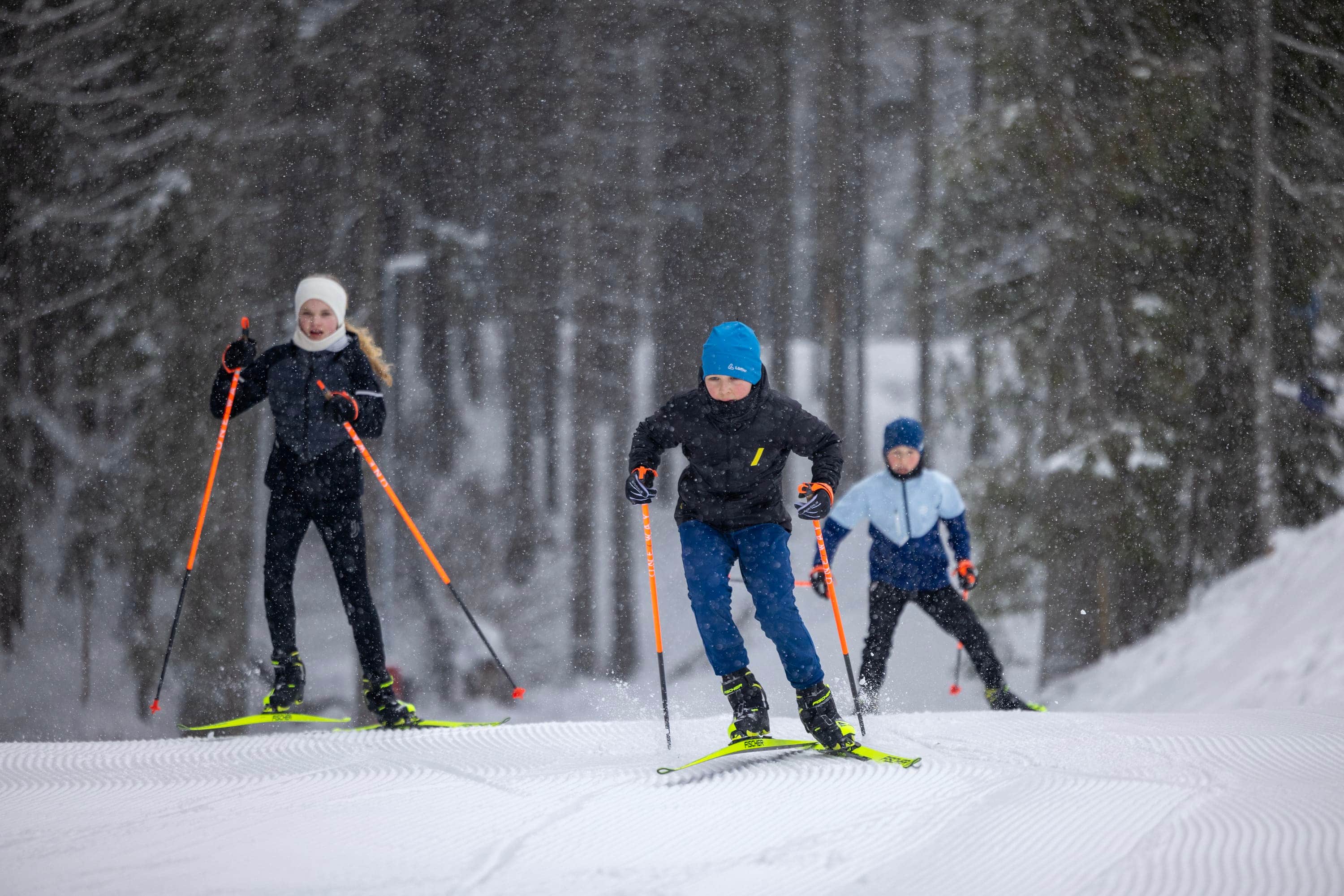
The length of cross-country skis
The optimum ski length for cross-country skiing depends first of all on the style you want to ski. You can then use your height as a guide:
Classic cross-country skiing on the trail: height plus 20 cm
Nordic Cruising: Body height
Skating: Body height plus 5-10 cm
As already mentioned, weight also plays a role in addition to height when cross-country skiing. In order for the skis to glide smoothly, your body weight must be ideally distributed over the ski surface. If in doubt, make the following adjustments accordingly:
Rather heavy: 5 cm more
Rather light: 5 cm less
If your weight is in the average range, simply stick to the base value you have already determined.
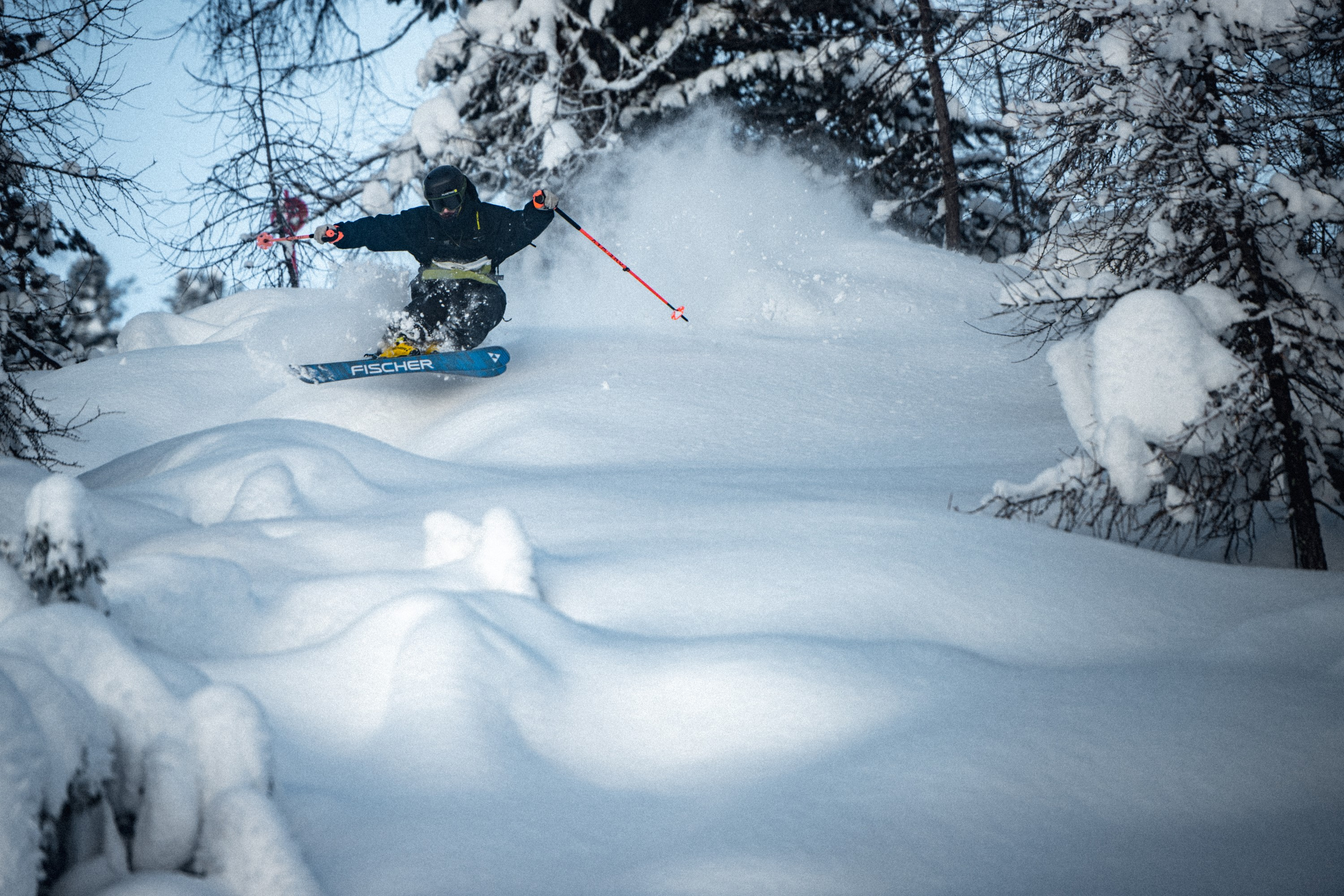
The freeride & touring ski length
Touring and freeride skis are adventurous and can handle a lot of terrain. However, this does not mean that they are similar in terms of length - quite the opposite:
Touring skis should be 5-15 cm shorter than your height. If you are very experienced, your touring ski can be just as long as you are. As a general rule, the longer your ski, the more comfortable it is to ski downhill. The shorter the ski, the easier it is to make hairpin turns on the way uphill.
Freeride skis should always match your height or be 5-15 cm taller. The longer the ski, the more lift you have in deep snow.
Do you often ski on paved slopes and love carving? Then you'll need a completely different length ratio for your skis...
The all-mountain ski length
All-mountain skis are designed for different terrain conditions. Accordingly, such skis tend to be longer and, depending on the model, can also ski larger radii. Which side of the length scale your ski should be on is best determined by your speed:
A long all-mountain ski is your candidate if you ski fast, are often off-piste and want a large radius.
A short all-mountain ski is suitable for you if you prefer to ski comfortably and above all on groomed slopes and like to make short turns.
And what does that mean in centimetres? Quite simply: you can use the table above as a guide!
The carving ski length
You can't really talk about the carving ski: again, it really depends on what you're buying your carving ski for! The individual carving models literally differ by lengths:
Allround (sports) carvers are between 165-180 cm long.
Slalom carvers are available in lengths of 155-170 cm.
Race carvers are around 170-185 cm.
These lengths have been specified by the German Ski Association. Basically, however, these are once again only guidelines that are not set in stone. The length you should choose for carving skis depends entirely on the terrain and how daring you are. A shorter ski, for example, is particularly maneuverable and suitable for slalom skiing, while a longer all-rounder will give you more float off-piste.

And what ski length do I need as a beginner?
You're thinking “off-piste” and just want to know what ski length you need for your first runs? Then it's best to stick to these tips:
The guideline for an all-round beginner's ski is body height minus 5-10 cm.
An all-rounder is generally a good choice for beginners. Such a ski is forgiving of many mistakes and runs best at a moderate to slow speed.
If in doubt, choose the slightly shorter ski. This is easier for beginners to control than a very long pair.
However, don't take the shortest skis you can get - on extremely short skis, skiing errors become noticeable much more quickly because you have less surface area and it becomes immediately apparent as soon as you shift your body weight incorrectly.
Admittedly, you can't find the right ski length in five minutes, but ideally in a consultation with an expert. But if that's not an option right now, our tips will put you on the right track to finding the right skis - and then all that's left to say is: Have fun skiing!