How long should ski poles be? Depending on use!
It may be hard to believe, but the length of the ski poles can influence your performance on and off the piste: Depending on your skiing style and terrain, you may need the poles more or less, shorter or longer. That's why it's important to choose the right size when buying ski poles - then nothing will stand in the way of fun in the snow! How can you calculate the length of your ski poles and why is the length of your ski poles linked to the way you use them? We want to answer these questions in our ski pole buying guide.
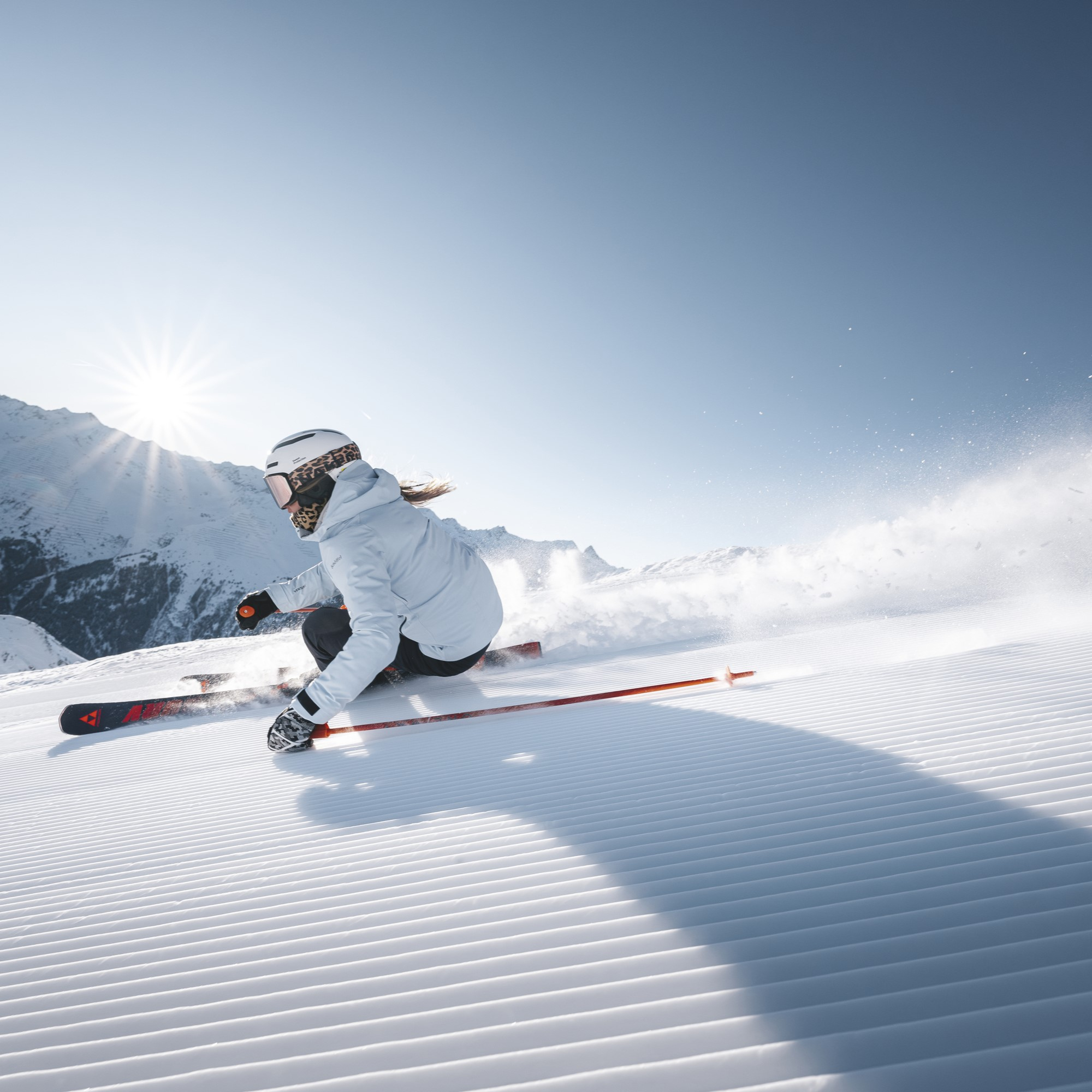
How long should ski poles be? Depending on use!
First things first: as with the choice of skis themselves, the choice of ski poles also depends on the area of use. Freeriders need a different pole length than racers. The reason is quite simple and can be observed every year in the sports program: To push yourself well at the start in a giant slalom, a longer pole is advisable - the power can work better this way due to the longer lever. On the other hand, shorter poles tend to be used when skiing down a mogul slope, as the skier moves more dynamically and is less stretched. Before we explain how to calculate the ski pole length, we want to give you an overview of the areas of use - because this is essentially related to the choice of ski pole size.
Alpine ski poles
Alpine ski poles are primarily intended to provide a comfortable effect on the piste that is adapted to your skiing style. The poles are mainly used to improve balance on the descent. Ski poles can also be very helpful for the correct timing when making short turns, for example.
For those who like to go fast, slightly longer poles are more suitable - these allow you to push off with your arms. Racing equipment therefore often includes very light ski poles with a curved shaft.
Ski poles for children
Ski poles for children are not only shorter, they also differ in other aspects. The tube is usually thinner and the grips are narrower so that children's delicate hands can hold the poles well. The point at which ski poles for children are purchased depends entirely on the ability of the young skier. When the child has internalized the essential movements of skiing and has already developed the necessary motor skills, such as not being overwhelmed when riding the lift with poles, then the right time has come.
Touring ski poles & how long ski poles should be for freeriders
Touring ski poles are usually telescopic poles, which means they can be individually adjusted in size. During the ascent, many people find a longer pole comfortable, which is of course always individually adjusted to the respective slope inclination. If you need to use your hands, for example when using ice axes, telescopic poles are no problem as they can be easily attached to your rucksack thanks to their adjustable size. The poles can then be shortened again for the descent. There is also a trend towards telescopic poles for freeriding, as they are ideal for negotiating moguls, deep snow or halfpipes..

Length of the ski poles: Two ways to determine
Your height is crucial when calculating the size of your ski poles. There are two ways to determine the correct size, one is theoretical and the other is based on a practical test.
1. calculate ski pole length with the formula
Not only Pythagoras knew that formulas can be very practical to make life easier in many ways, no: ski racers also use a formula to determine the length of their ski poles:
Height in cm x 0.7 = length of the ski pole in cm
No calculator to hand? The following table also gives you an overview of the pole lengths available on the market and for which body size they are suitable:
| Body size | Ski pole length |
|---|---|
| 99 - 105 cm | 70 cm |
| 106 - 112 cm | 75 cm |
| 113 - 119 cm | 80 cm |
| 120 - 126 cm | 85 cm |
| 127 - 133 cm | 90 cm |
| 134 - 140 cm | 95 cm |
| 141 - 147 cm | 100 cm |
| 148 - 154 cm | 105 cm |
| 155 - 161 cm | 110 cm |
| 162 - 168 cm | 115 cm |
| 169 - 175 cm | 120 cm |
| 176 - 182 cm | 125 cm |
| 183 - 189 cm | 130 cm |
| 190 - 196 cm | 135 cm |
| über 197 cm | 140 cm |
The result of the formula should not be set in stone, because of course individual aspects also play a role: upper body length, leg length, skiing style or the skier's personal preference. However, the result can certainly serve as an initial guide; the practical test provides more information about the correct pole length.
Freeriders can subtract approx. 5 cm from the recommended pole length! If the poles are used exclusively in the park, then even very short models are purchased: 1-meter ski poles are part of a freestyler's standard equipment in the park.
2. the practical test for the right ski pole length
If you want to test the length yourself directly on the model, you should carry out the test with ski boots and skis on your legs. Turn the pole upside down so that the handle is on the ground. Hold the pole below the plate in your hand and hold it in front of your upper body. The part above the plate is not needed for the measurement because it sinks into the snow anyway and is therefore not counted as part of the length of the pole.
If your upper arm forms a right angle with your forearm, then the pole is the right length for you. Alternatively, you can just use your forearm as a guide, if it is horizontal to the ground, then the size is ideal for you.
-> Expert tip: Try out the shorter or longer model, you will see how much difference a few centimetres can make!

The characteristics of ski poles:
If you think that buying ski poles is all about size, we're sorry to disappoint you. As already briefly mentioned, there is a suitable model for every area of use. So once you have determined the right ski pole size, you are faced with the next purchase decision. Racing poles for speed skiing, for example, are ergonomically shaped.
The material: aluminum, carbon, titanal
Differences in the material make the ski poles very light or rather heavy. Good ski poles have an ergonomically shaped grip - the ski pole can be gripped perfectly. The holding straps ensure that the poles do not immediately fall to the ground and slide down the slope if they are held loosely.
The tube material should be stable and light - many poles combine both aspects. High stability is important to ensure that the pole is not damaged by bumps and falls, especially in racing. If the ski pole does get bent, you can try to warm it up by rubbing it with your gloves and then bend it. In this way, the pole can sometimes be brought back into the correct shape.
Simpler ski poles are made of aluminum and are sufficient for skiing on the piste. However, if you fall, it can happen that a pole gets bent. However, there are also poles made of heat-treated aluminum - these are even stronger and more flexible. Many professionals use carbon poles - these are very light and very stiff.
Telescopic poles made of Titanal guarantee easy adjustment even in very cold temperatures. The plates can also be changed very easily, depending on the area of use.
Conclusion: Depending on how you ski and how you use your poles, it is better to choose the larger or smaller model. Often, however, it simply depends on the skier's personal preference. The formula for calculating ski poles should therefore only be an initial guide. The practical test will show which length is actually the right one - taking your personal skiing style into account, of course!
.jpg)